

As an Amazon Associate I earn from qualifying purchases.
A smart air conditioner lets you cool a room from your phone or with your voice: switch it on from the office so the bedroom is cool when you get home, set a schedule, or just say “Alexa, set the bedroom AC to 72.” The best smart air conditioner does that without being loud, hard to install or wasteful.
We first wrote this guide in 2020, and most of those units are no longer sold. This update has six current picks: four Wi-Fi window units, a portable AC for rooms where a window unit will not fit, and a smart controller that upgrades the air conditioner you already own.
| Product | Best for | Our rating | |
|---|---|---|---|
 Midea U-Shaped Smart Inverter | Best overallU-shaped inverter as quiet as 32 dBA, window still opens | ★★★★½ 4.5/5 | Check price |
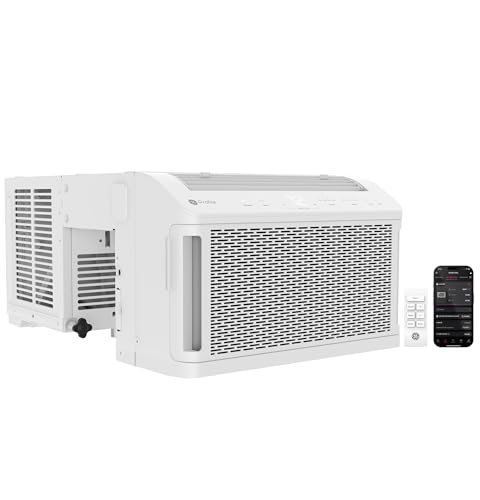 GE Profile ClearView | Best for small bedroomsSaddle design keeps the full window view, 41 dB for bedrooms | ★★★★½ 4.5/5 | Check price |
 Windmill Smart Inverter | Easiest installTool-free pre-assembled install kit and quiet inverter cooling | ★★★★½ 4.5/5 | Check price |
 LG Smart Window Air Conditioner | Best value10,000 BTU for medium rooms with LG ThinQ and voice control | ★★★★☆ 4/5 | Check price |
 BLACK+DECKER Smart Portable AC | Best portableRolls room to room, cools, dehumidifies, Follow Me remote | ★★★★☆ 4/5 | Check price |
 Sensibo Air PRO | Best AC controllerMakes any remote-controlled AC smart, with CO2 and TVOC sensors | ★★★★½ 4.5/5 | Check price |
How we picked the best smart air conditioners
Every pick here has to be a good air conditioner first. After that, we looked at how well the smart features work day to day, and at the things that decide whether you will be happy with it by August.
We have not lab tested these units, so we stick to what each maker says each one does and how it fits a room. The star ratings are our own editorial scores for how well each pick fits its role.
1. Midea U-Shaped Smart Inverter: best smart air conditioner overall
Midea U-Shaped Smart Inverter
A whisper-quiet window AC that still lets you open the window
A 10,000 BTU U-shaped inverter window unit for rooms up to 450 square feet, with Wi-Fi app control, Alexa and Google Assistant support and a window lock for safety.
The Midea U-Shaped Smart Inverter is the window unit we would buy for most rooms. Its U shape straddles the window sash, so the noisy part of the unit sits outside and the window itself blocks much of the sound. Midea rates it as low as 32 dBA, and you can still open the window for fresh air with the unit installed.
The inverter compressor speeds up and slows down instead of cycling on and off, which Midea says saves more than 37% on energy compared with traditional units. The 10,000 BTU model is sized for rooms up to about 450 square feet, and smaller versions are available.
For smart control, it connects to Wi-Fi and runs from the Midea SmartHome app, with voice control through Alexa or Google Assistant. A quick-snap bracket holds the unit, and it fits single- or double-hung windows 22 to 36 inches wide.
2. GE Profile ClearView: best smart window AC for small bedrooms
GE Profile ClearView
Keeps your full window view and runs quietly in a bedroom
A 6,100 BTU saddle-style window unit with SmartHQ app control, Alexa and Google Assistant, a flex-depth fit for thick walls and an automatic condensation pump.
The GE Profile ClearView takes a different route to the same goal: it sits on the sill in a saddle shape that keeps the full view through the window and lets the window open and close freely. GE rates it as low as 41 dB, which makes it a good fit for a bedroom or home office.
This 6,100 BTU model suits small rooms of roughly 150 to 250 square feet. It fits windows 20 to 40 inches wide, and its adjustable “flex-depth” design handles walls from 4.5 to 13.75 inches thick. An automatic pump moves condensation to the outdoor side, so in most conditions there is nothing to drain.
You control it with the GE SmartHQ app, with Alexa or Google Assistant, or with the included remote. The drawback is size: for a living room, step up to the 10,000 BTU ClearView or pick the Midea U.

3. Windmill Smart Inverter: easiest smart AC to install
Windmill Smart Inverter
A good-looking smart window AC you can install without tools
An 8,000 BTU inverter window unit for 250 to 350 square feet with a pre-assembled install kit, the Windmill Air app, voice control and auto-dimming lights.
The Windmill Smart Inverter AC is built for people who dread installing a window unit. It comes with a pre-assembled install kit and needs no tools, so most people can set it in the window and start cooling quickly. It also looks better than most, with clean lines and auto-dimming lights.
The 8,000 BTU model covers about 250 to 350 square feet. Windmill’s WhisperTech design pulls in air from the front and bottom for quiet, even cooling, and insulated side panels help keep the cold in and the street noise out.
You run it from the Windmill Air app or by voice with Alexa or Google Assistant. The drawback is that it is a conventional box shape, so unlike the Midea U and GE Profile ClearView it blocks the lower part of your window.
4. LG Smart Window Air Conditioner: best value for medium rooms
LG Smart Window Air Conditioner
Simple, affordable smart cooling for a medium-sized room
A 10,000 BTU window unit for up to 450 square feet with LG ThinQ app control, Alexa and Google Assistant support, an EZ Mount kit and a washable filter.
LG was one of our picks in 2020, and the LG Smart Window Air Conditioner (LW1017ERSM1) is the simple, good-value way to cool a medium room today. Its 10,000 BTU output covers up to about 450 square feet, and it installs in a double-hung window 22 to 36 inches wide with the included EZ Mount kit.
The LG ThinQ app lets you change the temperature from anywhere, and it works with Alexa and Google Assistant for voice control. A slide-out washable filter and a check-filter alert make upkeep easy.
The drawback is that it uses a standard fixed-speed compressor rather than an inverter, so expect it to be louder and less efficient than the Midea U or Windmill. For a living room or kitchen where a little noise does not matter, it is a smart buy.
5. BLACK+DECKER Smart Portable AC: best portable smart air conditioner
BLACK+DECKER Smart Portable AC
Smart cooling for rooms where a window unit will not fit
A 3-in-1 portable air conditioner, dehumidifier and fan (10,200 BTU SACC) with Wi-Fi app control, Alexa and Google Assistant, a window kit and a Follow Me remote.
Our old top pick was a portable, because some rooms simply cannot take a window unit: casement windows, rental rules or a room you only need to cool now and then. The BLACK+DECKER Smart Portable AC (BPACT14WT) fills that role today. It rolls between rooms and works as an air conditioner, dehumidifier and fan.
It connects to Wi-Fi for app control and works with Alexa and Google Assistant. The “Follow Me” remote has its own temperature sensor, so the unit cools to the temperature where you are sitting, not just where the AC stands.
The drawback is efficiency. Like every portable, it vents hot air through a hose to a window kit, and it takes up floor space. A window unit of the same rating will cool a room faster and more quietly.

6. Sensibo Air PRO: best smart AC controller for the AC you already own
Sensibo Air PRO
Turn the air conditioner you already own into a smart one
A smart controller for remote-controlled window units, portables and mini-splits, with app and voice control, geofencing, Climate React and built-in CO2 and TVOC sensors.
If your air conditioner works fine, you may not need a new one. The Sensibo Air PRO is a small controller that learns your AC’s remote and then sends the same infrared signals, so any remote-controlled window unit, portable or ductless mini-split becomes a smart air conditioner.
Once it is set up, you get app control from anywhere, schedules, and voice control with Alexa or Google Assistant. Geofencing turns the AC on as you head home and off when everyone leaves, and Climate React uses temperature and humidity to keep the room comfortable. The PRO adds CO2 and TVOC sensors, so it also tells you when the room needs fresh air, the same idea as our bedroom CO2 monitor picks.
The drawbacks: you need one Sensibo per air conditioner, and the AC must have an infrared remote. Older units with only push buttons on the front will not work.
Buying guide: how to choose a smart air conditioner
Start with the room, not the app. The wrong size wastes money no matter how smart the unit is, and the shape of your window decides which designs will fit.
Get the BTU size right
An air conditioner that is too small never catches up, and one that is too big cools the room before it removes the humidity, which leaves it damp and clammy. ENERGY STAR publishes a room air conditioner sizing chart based on an 8-foot ceiling:
- 100 to 150 sq ft: 5,000 BTU
- 150 to 250 sq ft: 6,000 BTU
- 250 to 350 sq ft: 7,000 to 8,000 BTU
- 350 to 450 sq ft: 9,000 to 10,000 BTU
- 450 to 550 sq ft: 12,000 BTU
Then adjust: reduce capacity by 10 percent for a heavily shaded room, add 10 percent for a very sunny one, add 600 BTU for each regular occupant beyond two, and add 4,000 BTU for a kitchen.
Window unit, portable or controller
- Window unit: the most cooling for the money. U-shaped and saddle designs are the quietest and keep more of your view.
- Portable: for casement or sliding windows and rentals that ban window units. Less efficient, so size it by its SACC rating.
- Smart controller: for an AC you already own that has an infrared remote. The cheapest way to add app and voice control.
Smart features that matter
Look for an app with schedules, remote on and off, and voice control with the assistant you use. Not sure which Alexa speaker to put in the room? See which Echo you should buy. Each maker uses its own app, so a house with several brands means several apps, unless you control them all through Alexa, Google Home or a Sensibo.
Energy use and running costs
Inverter models such as the Midea U and Windmill use noticeably less power than fixed-speed units. ENERGY STAR also notes that many certified connected room ACs are “smart-grid ready,” which can qualify you for utility savings programs in some areas.
Smart scheduling helps too. If you also have central air, our look at whether a smart thermostat is worth it and our Alexa-compatible thermostat picks cover the whole-house side, and the energy-monitoring smart plugs guide shows how to measure what a device really uses. You can also read how my smart home saves me money every year.
Smart AC or smart AC controller?
If you like your current air conditioner and it has an infrared remote, a controller like the Sensibo Air PRO is the budget-friendly upgrade: you get the same app control, schedules and voice commands without buying a new unit.
Buy a new smart air conditioner instead if your old unit is loud, short of capacity or more than about ten years old, or if it has only push buttons. A modern inverter unit like the Midea U-Shaped Smart Inverter will also be quieter and cheaper to run, and pairing any AC with a smart circulator fan spreads the cool air further.
Frequently asked questions
What is the best smart air conditioner?
For most rooms, the Midea U-Shaped Smart Inverter. It is very quiet, efficient, lets you open the window with the unit installed, and works with its app, Alexa and Google Assistant. For a small bedroom, the GE Profile ClearView is a great alternative, and the Sensibo Air PRO makes an existing AC smart.
Can I make my existing air conditioner smart?
Yes, if it has an infrared remote. A smart AC controller such as the Sensibo Air PRO learns the remote’s signals and sends them for you, adding app control, schedules, geofencing and voice control. Units with only front-panel buttons will not work, and you need one controller per AC.
Do smart air conditioners work with Alexa?
All six picks here work with Alexa and Google Assistant once you link the maker’s app. You can then say things like “Alexa, turn on the bedroom AC” or set the temperature by voice, and add the AC to routines with your lights and fans.
What size smart air conditioner do I need?
Use the ENERGY STAR chart: about 6,000 BTU for 150 to 250 square feet, 8,000 BTU up to 350, 10,000 BTU up to 450 and 12,000 BTU up to 550. Add 10 percent for a very sunny room, 600 BTU for each regular occupant beyond two and 4,000 BTU for a kitchen.
Are smart air conditioners worth it?
For most people, yes. Being able to start cooling before you get home, run schedules and switch off a unit you forgot is convenient and can cut wasted run time. The smart features add little to the price of a modern window unit, and a controller can upgrade an older AC.
Smart Thermostat are getting much more advanced with time. With the increase in home automation technology it will become possible to switch mode on commands.